Hidden Layers & Activation Functions: Solving the Saturation Problem
হিডেন লেয়ার ও অ্যাক্টিভেশন ফাংশন: স্যাচুরেশন প্রবলেমের সমাধান
Welcome back! Today we are diving deep into the very heart of a Neural Network: The Hidden Layers and their Activation Functions. Let's unravel this mystery together with a fun workplace analogy!
How do Hidden Layers Work?
Think of a hidden layer as a team of analysts in an office. Each analyst (neuron) in a hidden layer takes the reports (outputs) from the previous team, mixes them together based on how important they think each report is (a weighted linear combination), and produces a single summarized value to pass forward to the boss.
Mathematically, it looks like this: $y = r(w^T x + b)$. Here, that $r(\cdot)$ part is incredibly important. We call it the Activation Function. It decides whether the analyst should actually send the report forward or just throw it in the trash.
Some classic activation functions include:
- Threshold: $t(z) = \mathbb{I}[z \ge 0]$ (If the report is positive, send a "1". Otherwise, send "0").
- Sigmoid: $\sigma(z) = 1 / (1 + \exp(-z))$ (Smoothly outputs a value between 0 and 1. Like saying, "I'm 80% sure this is good").
- Tanh: $\tanh(z) = 2\sigma(2z) - 1$ (Smoothly outputs between -1 and +1).
The Dreaded 'Saturation Problem' (The Lazy Worker)
For a long time, researchers loved Sigmoid and Tanh. But there was a massive problem hidden inside them, called Saturation.
Look at this graph:
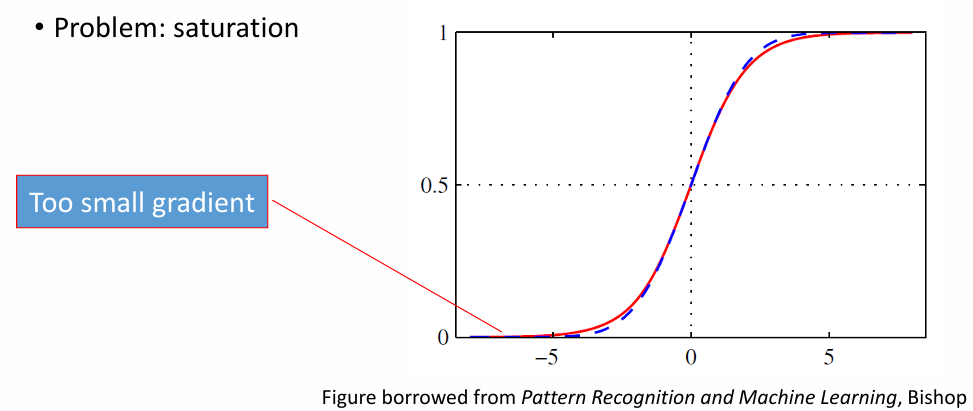
Imagine a lazy office worker. If you give him a normal amount of work (inputs near 0), he responds normally. But if you give him a massive pile of work (a very large positive number) or absolutely nothing (a very large negative number), he just gives up and stops responding!
On the graph, when the input $z$ gets really large or really small, the curve becomes completely flat. When a curve is flat, its slope (or gradient) becomes almost zero. This "Too small gradient" completely halts the learning process (Backpropagation) of the network. The network simply stops learning because the "lazy workers" refuse to pass any new information backward!
The Hero: ReLU (Rectified Linear Unit - The Eager Worker)
To solve this, researchers fired the lazy workers and brought in ReLU, which is now the most popular activation function in Deep Learning! Its formula is wonderfully simple: $\text{ReLU}(z) = \max{z, 0}$.
Let's look at its graph:
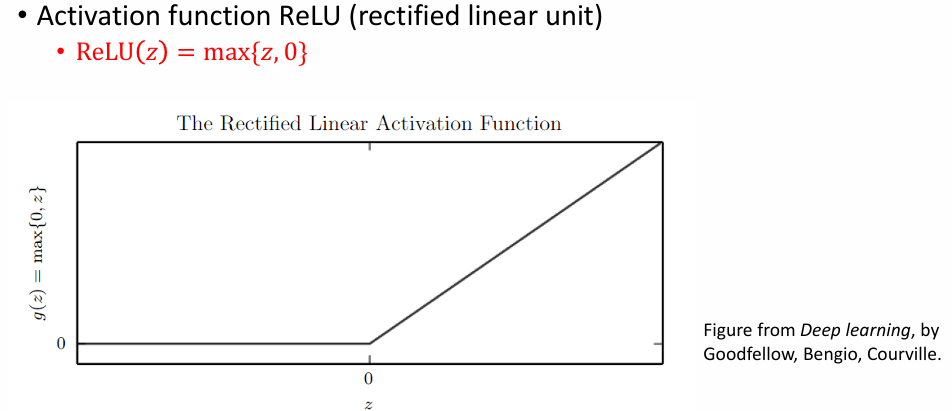
ReLU is an eager, straightforward worker. If you give him negative work (useless information), he just says "Nope!" and outputs 0 (gradient is 0). But if you give him positive work, he enthusiastically passes it along exactly as it is! Because it is a perfectly straight line on the positive side, its gradient is exactly 1.
No flatness, no saturation! The network can learn incredibly fast because the eager workers always pass the feedback perfectly.
Generalizations of ReLU: Sometimes, having the negative side completely dead (0) is a problem (what if all workers just say "Nope" and go to sleep?). So we tweak it:
- Leaky-ReLU: We tell the worker, "If it's negative, just mumble a little bit." We add a tiny, fixed slope (like 0.01) on the negative side.
- Parametric-ReLU (PReLU): We let the model itself learn exactly how much the worker should mumble on the negative side during training!
[!NOTE] IMPORTANT NOTES FOR NOTEBOOK Concept: Hidden Layer Activation Functions & Saturation Key Point 1: Classical smooth activations (Sigmoid, Tanh) suffer from saturation, leading to vanishing gradients when inputs take large values. Key Point 2: ReLU ($\max{0, z}$) provides a constant gradient of 1 for positive activations, effectively mitigating the saturation problem. Advantage: ReLU speeds up computation and gradient flow significantly, enabling the successful training of very deep architectures. Disadvantage: In standard ReLU, neurons outputting negative values encounter a zero gradient, leading to "dead neurons" where updates permanently halt (the dying ReLU problem).
আবারও স্বাগতম! আজ আমরা একটি নিউরাল নেটওয়ার্কের একদম প্রাণকেন্দ্রে প্রবেশ করবো, আর সেটি হলো Hidden Layers (হিডেন লেয়ার) এবং তাদের Activation Functions (অ্যাক্টিভেশন ফাংশন)। চলো, একসাথে অফিসের দারুণ একটি উদাহরণ দিয়ে এর রহস্য উন্মোচন করি!
হিডেন লেয়ার কীভাবে কাজ করে?
হিডেন লেয়ারকে একটি অফিসের একদল অ্যানালিস্ট বা বিশ্লেষক হিসেবে চিন্তা করো। একটি হিডেন লেয়ারের প্রতিটি অ্যানালিস্ট (নিউরন) তার আগের টিমের কাছ থেকে রিপোর্ট (আউটপুট) গ্রহণ করে, সেগুলোর গুরুত্ব বুঝে একসাথে মেশায় (weighted linear combination), এবং একটি নির্দিষ্ট রিপোর্ট তৈরি করে বসের কাছে পাঠায়।
গাণিতিকভাবে সমীকরণটি হলো: $y = r(w^T x + b)$। এখানে এই $r(\cdot)$ অংশটি অত্যন্ত গুরুত্বপূর্ণ। একেই আমরা বলি অ্যাক্টিভেশন ফাংশন। এটিই সিদ্ধান্ত নেয় যে অ্যানালিস্ট কি আসলেই রিপোর্টটি বসের কাছে পাঠাবে নাকি সোজা ডাস্টবিনে ফেলে দেবে!
প্রচলিত কিছু অ্যাক্টিভেশন ফাংশন হলো:
- Threshold: $t(z) = \mathbb{I}[z \ge 0]$ (রিপোর্ট পজিটিভ হলে "১" পাঠাবে, নইলে "০")।
- Sigmoid: $\sigma(z) = 1 / (1 + \exp(-z))$ (আউটপুটকে ০ থেকে ১ এর মধ্যে মসৃণভাবে রাখে। অনেকটা এমন বলার মতো— "আমি ৮০% শিওর যে এটা ভালো রিপোর্ট")।
- Tanh (Hyperbolic Tangent): $\tanh(z) = 2\sigma(2z) - 1$ (-১ থেকে +১ এর মধ্যে মান দেয়)।
ভয়ংকর 'স্যাচুরেশন প্রবলেম' (অলস কর্মী)
দীর্ঘদিন ধরে গবেষকরা Sigmoid এবং Tanh ব্যবহার করতে ভালোবাসতেন। কিন্তু এগুলোর ভেতরে একটি বিশাল সমস্যা লুকিয়ে ছিল, যার নাম Saturation।
নিচের গ্রাফটি একটু দেখো:
ধরে নাও একজন ভীষণ অলস কর্মীর কথা। তুমি যদি তাকে স্বাভাবিক পরিমাণ কাজ দাও (০ এর কাছাকাছি), সে ঠিকমতো রেসপন্স করে। কিন্তু তুমি যদি তাকে বিশাল বড় একটি কাজের পাহাড় ধরিয়ে দাও (বড় পজিটিভ নম্বর) অথবা একদম কোনো কাজই না দাও (বড় নেগেটিভ নম্বর), সে হাল ছেড়ে দিয়ে একদম রেসপন্স করা বন্ধ করে দেয়!
গ্রাফে দেখো, যখন ইনপুট $z$ এর মান খুব বড় বা খুব ছোট হয়, তখন কার্ভ বা রেখাটি একদম ফ্ল্যাট বা সমান্তরাল হয়ে যায়। আর আমরা জানি, রেখা ফ্ল্যাট হয়ে গেলে এর ঢাল বা গ্রাডিয়েন্ট প্রায় শূন্য হয়ে যায়। এই "Too small gradient"-এর কারণে ব্যাকপ্রোপাগেশন (Backpropagation) বা মডেলের শেখার প্রক্রিয়া মারাত্মকভাবে ব্যাহত হয়। মডেলটি নতুন কিছু শেখা একদম বন্ধ করে দেয়, কারণ এই অলস কর্মীরা নতুন কোনো তথ্য পেছনে পাঠাতেই রাজি হয় না!
হিরো এন্ট্রি: ReLU (চটপটে কর্মী)
এই স্যাচুরেশন প্রবলেম সমাধান করার জন্য গবেষকরা অলস কর্মীদের ফায়ার করে নিয়ে এলেন ReLU, যা বর্তমানে ডিপ লার্নিংয়ের সবচেয়ে জনপ্রিয় অ্যাক্টিভেশন ফাংশন! এর সমীকরণটি চমৎকার এবং একদম সহজ: $\text{ReLU}(z) = \max{z, 0}$।
চলো এর গ্রাফটি দেখি:
ReLU হলো একজন চটপটে ও সোজাসাপ্টা কর্মী। তুমি যদি তাকে নেগেটিভ বা ফালতু কাজ দাও, সে সোজাসুজি বলে দেয় "করবো না!" এবং আউটপুট ০ দিয়ে দেয়। কিন্তু তুমি যদি তাকে পজিটিভ কাজ দাও, সে অত্যন্ত উৎসাহের সাথে কাজটা ঠিক যেমন আছে তেমনই বসের কাছে পাঠিয়ে দেয়! যেহেতু পজিটিভ পাশে এটি একটি সোজা সরলরেখা, তাই এর গ্রাডিয়েন্ট সবসময় ১ থাকে।
কোনো ফ্ল্যাটনেস নেই, কোনো স্যাচুরেশন নেই! ফলে নেটওয়ার্ক অবিশ্বাস্য দ্রুতগতিতে শিখতে পারে, কারণ এই চটপটে কর্মীরা ফিডব্যাক খুব সুন্দরভাবে পাস করে দেয়।
ReLU-এর জেনারেলাইজেশন: মাঝে মাঝে নেগেটিভ পাশটা পুরোপুরি মরে (০ হয়ে) যাওয়াটা একটা সমস্যা তৈরি করে (সব কর্মী যদি "করবো না" বলে ঘুমিয়ে পড়ে, তাহলে তো বিপদ!)। তাই এতে কিছু পরিবর্তন আনা হয়:
- Leaky-ReLU: এখানে আমরা কর্মীকে বলি, "যদি কাজটা নেগেটিভও হয়, তবুও বিড়বিড় করে কিছু একটা অন্তত বোলো।" তাই ঋণাত্মক অংশে হালকা একটি ফিক্সড ঢাল (যেমন 0.01) যোগ করা হয়।
- Parametric-ReLU (PReLU): এখানে ঋণাত্মক অংশের ঢালটি কত হবে (অর্থাৎ কর্মী কতটা বিড়বিড় করবে), মডেল নিজেই ট্রেনিংয়ের সময় ডেটা থেকে তা শিখে নেয়!
[!NOTE] IMPORTANT NOTES FOR NOTEBOOK Concept: Hidden Layer Activation Functions & Saturation Key Point 1: Classical smooth activations (Sigmoid, Tanh) suffer from saturation, leading to vanishing gradients when inputs take large values. Key Point 2: ReLU ($\max{0, z}$) provides a constant gradient of 1 for positive activations, effectively mitigating the saturation problem. Advantage: ReLU speeds up computation and gradient flow significantly, enabling the successful training of very deep architectures. Disadvantage: In standard ReLU, neurons outputting negative values encounter a zero gradient, leading to "dead neurons" where updates permanently halt.