Inside a Neural Network: Components & Output Layers
নিউরাল নেটওয়ার্কের ভেতরে: কম্পোনেন্ট ও আউটপুট লেয়ার
Hello again! Welcome back to our Deep Learning journey. Today we are going to look under the hood of a Neural Network and understand exactly what it is made of, how we prepare data for it, and how it delivers its final answer!
Think of a Neural Network like a high-end MasterChef kitchen. Let's see how the cooking process works!
Structural Components of a Network
A feedforward neural network basically consists of two main types of things:
- Representations (The Ingredients): This includes the raw Input data (the raw vegetables) and the Hidden variables generated inside the intermediate layers (the half-cooked meals).
- Layers/Weights (The Chefs & Ovens): This includes the Hidden layers and the final Output layer. These layers contain the mathematical weights that the network learns. The chefs take the ingredients, apply their specific weights (recipes and heat), and pass them to the next station.
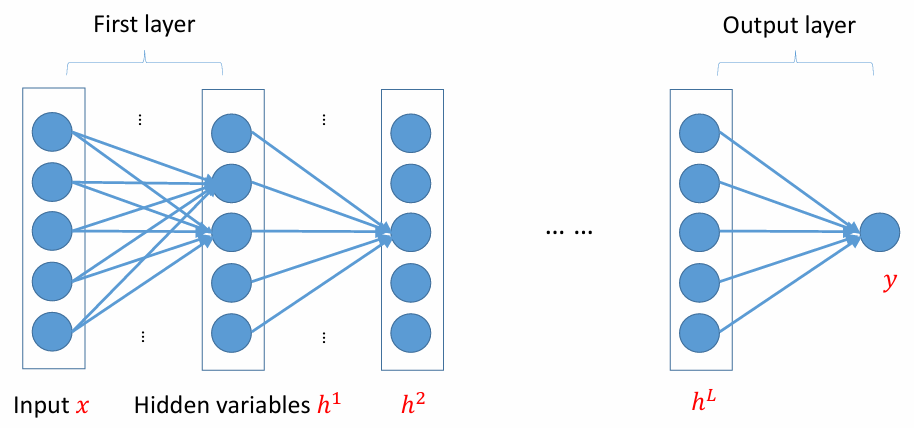
Take a look at this diagram showing how information flows from the input layer, through the first and second hidden layers, all the way to the output $y$:
The Magic of Preprocessing (Washing the Veggies)
Before we throw our data into a neural network, it must be represented as a Vector. But if we feed raw, unpolished data into the model, it might get confused or train very slowly. Imagine throwing a whole, unpeeled potato directly into a frying pan! It won't cook well. That is why Preprocessing (washing and chopping) is crucial!
Usually, we do two main things to our data:
- Subtract the mean: We find the average of the data and subtract it to center our values. This is like removing the excess dirt from the vegetables.
- Normalize: We squeeze the data range into a specific boundary, like
[-1, 1]. This is like chopping all vegetables into equal-sized pieces so they cook evenly!
Why do this? If the data is normalized, the network's optimization process becomes much faster and highly stable. It prevents numbers from getting ridiculously large or small.
Configuring the Output Layer (Serving the Dish)
After all the hidden layers (the chefs) do their heavy lifting, the final layer—the Output Layer (the head waiter)—must be set up depending on the exact problem we are trying to solve or how the customer wants their food served. Here are the 4 main configurations I learned:
- Regression (Predicting a single number): If we are predicting a house price (or asking "How many calories are in this dish?"), the equation is simply $y = w^T h + b$. We just multiply the hidden variables by weights. No non-linear activation (Linear unit) is used here.
- Multi-dimensional Regression (Predicting multiple numbers): If we need to predict several numbers at once (like "Calories, Carbs, and Protein"), the equation becomes $y = W^T h + b$. Notice the capital $W$ (a large weight matrix). Still no non-linearity!
- Binary Classification (Yes/No questions): "Is this email spam or not?" (or "Is this dish spicy or not?"). We use the Sigmoid function: $y = \sigma(w^T h + b)$. It works like Logistic Regression, converting the output into a probability between 0 and 1.
- Multi-class Classification (Choosing from many categories): "Is this picture a cat, a dog, or a bird?" (or "Is this dish Italian, Mexican, or Chinese?"). First, we calculate a linear score $z = W^T h + b$. Then we pass it through a Softmax function: $y = \text{softmax}(z)$, which gives us a neat probability distribution across all classes!
[!NOTE] IMPORTANT NOTES FOR NOTEBOOK Concept: Network Components & Output Formulations Key Point 1: A network consists of representations (input, hidden variables) and functional layers (hidden/output layers with weight matrices). Key Point 2: For continuous tasks (Regression), a purely linear unit is used. For categorical tasks, Sigmoid handles binary outputs while Softmax handles multi-class outputs. Advantage: Proper preprocessing prevents exploding/vanishing gradients, and correct output configurations ensure the loss calculation aligns perfectly with the target metric. Disadvantage: Using incorrect output bounds (e.g., using a linear unit instead of softmax for classification) will cause training to fail completely because the mathematical ranges will not match the loss function expectations.
হ্যালো! আমাদের ডিপ লার্নিং জার্নিতে আবার স্বাগতম! আজ আমরা একটি নিউরাল নেটওয়ার্কের ভেতরে উঁকি দেবো এবং বোঝার চেষ্টা করবো ঠিক কী কী দিয়ে এটি তৈরি, ডেটা দেওয়ার আগে কেন তা প্রস্তুত করতে হয় এবং একদম শেষের আউটপুট লেয়ারটি কীভাবে কাজ করে!
পুরো জিনিসটাকে আমরা মাস্টারশেফ রান্নাঘরের একটি মজার উদাহরণ দিয়ে বুঝবো। চলো শুরু করি!
নেটওয়ার্কের মূল উপাদান (Structural Components)
একটি ফিডফরওয়ার্ড নেটওয়ার্কে মূলত দুই ধরনের জিনিস থাকে: ১. Representations (রান্নার উপকরণ): এর মধ্যে রয়েছে আমাদের দেওয়া ইনপুট ডেটা (কাঁচা শাকসবজি) এবং ভেতরের লেয়ারগুলোতে তৈরি হওয়া হিডেন ভ্যারিয়েবলস (অর্ধেক রান্না করা খাবার)। ২. Layers/Weights (শেফ ও ওভেন): এর মধ্যে রয়েছে ভেতরের হিডেন লেয়ারসমূহ এবং একদম শেষের আউটপুট লেয়ার। এই লেয়ারগুলোতেই গাণিতিক ওয়েট থাকে যা মডেল আস্তে আস্তে শেখে। শেফরা উপকরণগুলো নিয়ে তাদের নিজেদের নির্দিষ্ট ওয়েট (রেসিপি ও তাপ) অনুযায়ী প্রসেস করে পরের স্টেশনে পাঠিয়ে দেয়।
নিচের ডায়াগ্রামটি লক্ষ্য করো, এখানে দেখানো হয়েছে কীভাবে ইনপুট থেকে শুরু করে প্রথম ও দ্বিতীয় হিডেন লেয়ারের মাধ্যমে তথ্য সামনের দিকে এগিয়ে যায় এবং শেষ পর্যন্ত আউটপুট $y$ পাওয়া যায়:
প্রিপ্রসেসিংয়ের ম্যাজিক (সবজি ধোয়া ও কাটা)
নিউরাল নেটওয়ার্কে ইনপুট ডেটাকে সবসময় একটি Vector (ভেক্টর) হিসেবে দিতে হয়। কিন্তু সরাসরি র-ডেটা (raw data) দিলে মডেল হয়তো কনফিউজড হয়ে যাবে বা খুব ধীরগতিতে কাজ করবে। চিন্তা করো, একটা আস্ত খোসাওয়ালা আলুকে যদি তুমি সরাসরি ফ্রাইং প্যানে দিয়ে দাও, সেটা কি ঠিকমতো রান্না হবে? একদমই না! ঠিক এই কারণেই Preprocessing (ধোয়া এবং কাটা) অত্যন্ত জরুরি!
সাধারণত আমরা ডেটার ওপর দুটি প্রধান কাজ করি:
- গড় বা মিন বিয়োগ করা (Subtract mean): ডেটার গড় বের করে তা সব ডেটা থেকে বিয়োগ করা হয়, যাতে ডেটা সেন্টার্ড বা মাঝবরাবর থাকে। এটা হলো সবজির গায়ের অতিরিক্ত ময়লা ধুয়ে ফেলার মতো।
- নরমালাইজ (Normalize): ডেটার রেঞ্জকে একটি নির্দিষ্ট সীমার মধ্যে (যেমন
[-1, 1]) নিয়ে আসা হয়। এটা হলো সবজিগুলোকে সমান সাইজে টুকরো টুকরো করে কাটার মতো, যাতে সবগুলো সমানভাবে রান্না হয়!
কেন এটা করা হয়? ডেটা নরমালাইজড থাকলে নেটওয়ার্কের অপ্টিমাইজেশন বা লার্নিং প্রসেস অনেক দ্রুত এবং স্থিতিশীল হয়! সংখ্যাগুলো অকারণে অনেক বড় বা অনেক ছোট হয়ে যায় না।
আউটপুট লেয়ার কনফিগারেশন (খাবার পরিবেশন)
নেটওয়ার্কের ভেতরের সব শেফদের কঠিন কাজ শেষ হওয়ার পর একদম শেষ স্তর অর্থাৎ Output Layer (হেড ওয়েটার)-টি কেমন হবে, তা নির্ভর করে আমরা কী ধরনের সমস্যার সমাধান করছি বা কাস্টমার কীভাবে খাবারটি চাইছে তার ওপর। আমি ৪টি ভিন্ন কনফিগারেশন শিখেছি:
১. Regression বা রিগ্রেশন (একটি সংখ্যা প্রেডিক্ট করা): যখন আমরা কোনো একক কন্টিনিউয়াস সংখ্যা (যেমন কোনো বাড়ির দাম বা "এই খাবারে কত ক্যালরি আছে?") প্রেডিক্ট করতে চাই, তখন সমীকরণটি হয়: $y = w^T h + b$। এখানে হিডেন ভ্যারিয়েবলের সাথে ওয়েট গুণ করে আউটপুট নেওয়া হয় এবং কোনো নন-লিনিয়ার অ্যাক্টিভেশন (Linear unit) ব্যবহার করা হয় না। ২. Multi-dimensional Regression (একাধিক সংখ্যা প্রেডিক্ট করা): যদি একসাথে একাধিক সংখ্যা প্রেডিক্ট করতে হয় (যেমন "ক্যালরি, শর্করা ও প্রোটিন কত?"), তখন সমীকরণটি দাঁড়ায়: $y = W^T h + b$। এখানে $W$ একটি বড় ওয়েট ম্যাট্রিক্স। এক্ষেত্রেও কোনো নন-লিনিয়ারিটি থাকে না। ৩. Binary Classification বা বাইনারি ক্লাসিফিকেশন (হ্যাঁ/না): "ইমেইলটি কি স্প্যাম নাকি স্প্যাম নয়?" (বা "খাবারটি কি ঝাল নাকি মিষ্টি?")। এ ধরনের ক্ষেত্রে আমরা ব্যবহার করি Sigmoid ফাংশন: $y = \sigma(w^T h + b)$। এটি লজিস্টিক রিগ্রেশনের মতো কাজ করে, যা আউটপুটকে ০ থেকে ১ এর মধ্যে একটি সম্ভাবনায় (probability) রূপান্তর করে। ৪. Multi-class Classification (অনেকগুলোর মধ্যে একটি বেছে নেওয়া): "ছবিটি কি বিড়াল, কুকুর নাকি পাখির?" (বা "এটি কি ইতালিয়ান, মেক্সিকান নাকি চাইনিজ খাবার?")। এক্ষেত্রে প্রথমে লিনিয়ার স্কোর $z = W^T h + b$ হিসাব করা হয়। এরপর ফাইনাল আউটপুট পাওয়া যায় Softmax ফাংশন ব্যবহার করে: $y = \text{softmax}(z)$। এটি সব ক্লাসের মধ্যে একটি সুন্দর ডিস্ট্রিবিউশন তৈরি করে দেয়!
[!NOTE] IMPORTANT NOTES FOR NOTEBOOK Concept: Network Components & Output Formulations Key Point 1: A network consists of representations (input, hidden variables) and functional layers (hidden/output layers with weight matrices). Key Point 2: For continuous tasks (Regression), a purely linear unit is used. For categorical tasks, Sigmoid handles binary outputs while Softmax handles multi-class outputs. Advantage: Proper preprocessing prevents exploding/vanishing gradients, and correct output configurations ensure the loss calculation aligns perfectly with the target metric. Disadvantage: Using incorrect output bounds (e.g., using a linear unit instead of softmax for classification) will cause training to fail completely because the mathematical ranges will not match the loss function expectations.