From Classic ML to Representation Learning: The Core Ideas
ক্লাসিক্যাল মেশিন লার্নিং থেকে রিপ্রেজেন্টেশন লার্নিং: কোর আইডিয়া!
Hello everyone! Today I officially started studying the Deep Learning Basics series (specifically based on the awesome COS 495 course by Yingyu Liang at Princeton University). Honestly, it feels like stepping into a completely new, magical world of AI!
At first, I thought Deep Learning was just a buzzword, but the mathematical elegance behind it blew my mind. Let me share what I learned today in a simple, story-like way, complete with some analogies to make it super easy to digest.
The Classic Machine Learning 1-2-3 (The Traditional Recipe)
Before diving into the deep waters of neural networks, we need to understand how traditional Machine Learning works. Think of it like baking a cake. It basically follows a simple 3-step recipe:
- Step 1 (Collect Data & Extract Features): We gather data, but computers are like babies; they don't understand raw data (like image pixels) very well. If you want a computer to recognize a house, you can't just give it a picture. You have to manually extract necessary traits, called Features (e.g., number of windows, roof shape, color).
- Step 2 (Build a Model): We choose a mathematical model (a Hypothesis class—think of this as our baking mold) and a way to measure our mistakes (a Loss function—think of this as our taste test).
- Step 3 (Optimization): Finally, we tweak the model's parameters to minimize our mistakes (empirical loss) so it becomes a prediction master!
What are 'Features' and Why Do They Matter?
Let's talk more about Features. Imagine you are trying to teach a child what a "Dog" is. Traditional ML is like handing the child a spreadsheet that says: "Has 4 legs, barks, has fur." This extracted information is our feature, represented mathematically as $\phi(x)$.
But why is this mathematical mapping so critical? Let me give you a fun example! Imagine your room is a mess. Your red toys and blue toys are scattered all over the floor in a 2D space. Your mom tells you to separate them by drawing a single straight line on the floor. But they are so mixed up, you simply cannot draw a straight line to separate them (this is called being non-linearly separable).
But, what if you use a clever feature mapping $\phi(x)$ to throw the red toys up into the air (projecting this data into a 3D space)? Suddenly, they separate beautifully! While the red toys are in the air and blue toys are on the floor, you can just slide a flat 2D cardboard sheet right between them!
Take a look at this illustration to see what I mean:
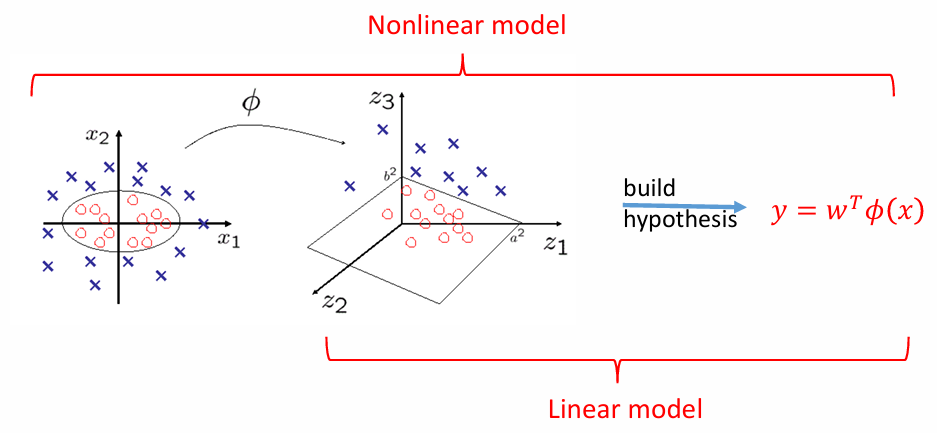
In classical models like Polynomial Kernel SVM, humans had to hand-design these clever $\phi(x)$ formulas. It was exhausting! If the human expert's feature engineering was bad, the model failed completely.
The Game Changer: Representation Learning
This is where the real magic of Deep Learning happens! Scientists eventually got tired and asked a brilliant question: "Instead of humans breaking their brains to design $\phi(x)$, why don't we let the computer learn it by itself?"
And that is Representation Learning. Instead of giving the child a spreadsheet of "dog features", Representation Learning is like just showing the child 1,000 pictures of dogs and saying, "Figure it out yourself!"
The model takes the raw data (pixels) and automatically discovers the most useful internal representations or features $\phi(x)$ while simultaneously learning the weights ($w$) to classify them. It looks at the images and slowly realizes, "Oh, pointy ears and a snout usually mean it's a dog!" No more tedious manual feature engineering!
[!NOTE] IMPORTANT NOTES FOR NOTEBOOK Concept: Representation Learning Key Point 1: Traditional ML relies on handcrafted features ($\phi(x)$) followed by linear model optimization. This requires extreme domain expertise. Key Point 2: Representation learning automatically learns both the optimal feature mapping $\phi(x)$ and the model weights ($w$) simultaneously from raw data. Advantage: Eliminates manual feature engineering, allowing models to adapt to complex, high-dimensional spaces easily and discover patterns humans might miss. Disadvantage: Requires massive amounts of data and sheer computational power to optimize everything from scratch. It is notoriously data-hungry!
হ্যালো বন্ধুরা! আজ আমি ডিপ লার্নিংয়ের বেসিকস নিয়ে পড়াশোনা শুরু করেছি (প্রিন্সটন ইউনিভার্সিটির ইনস্ট্রাক্টর Yingyu Liang-এর লেকচারের ওপর ভিত্তি করে)। সত্যি বলতে, ডিপ লার্নিং শব্দটা আগে শুধু শুনতাম, কিন্তু আজ এর ভেতরের গাণিতিক সৌন্দর্য দেখে মনে হচ্ছে যেন আর্টিফিশিয়াল ইন্টেলিজেন্সের এক জাদুকরী দুনিয়ায় পা রাখলাম! চলো, আজকে আমি যা যা শিখলাম তা একদম সহজ ভাষায়, বাস্তব জীবনের কিছু মজার উদাহরণ দিয়ে তোমাদের সাথে শেয়ার করি।
ক্লাসিক্যাল মেশিন লার্নিংয়ের ১-২-৩ (প্রথাগত রেসিপি)
ডিপ নিউরাল নেটওয়ার্কে ঝাঁপ দেওয়ার আগে আমাদের বুঝতে হবে প্রথাগত বা ট্র্যাডিশনাল মেশিন লার্নিং কীভাবে কাজ করে। ধরো, তুমি কেক বানাচ্ছো। মেশিন লার্নিংও ঠিক সেরকম ৩টি সহজ ধাপে কাজ করে:
১. ধাপ ১ (ডেটা সংগ্রহ ও ফিচার এক্সট্রাক্ট): প্রথমে আমরা ডেটা সংগ্রহ করি। কিন্তু কম্পিউটার তো ছোট বাচ্চার মতো, সে সরাসরি র-ডেটা (যেমন ইমেজের পিক্সেল) ভালোভাবে বোঝে না। তুমি যদি তাকে একটা বাড়ির ছবি দাও, সে বুঝবে না। তাই আমরা নিজেরা বুদ্ধি খাটিয়ে সেখান থেকে প্রয়োজনীয় বৈশিষ্ট্য বা Features এক্সট্রাক্ট করি (যেমন- কয়টা জানালা, ছাদের রঙ কী ইত্যাদি)। ২. ধাপ ২ (মডেল তৈরি): এরপর একটি গাণিতিক মডেল সিলেক্ট করতে হয়। একে বলে Hypothesis class (ভাবতে পারো এটা আমাদের কেক বানানোর ছাঁচ)। আর আমাদের ভুল মাপার জন্য একটি Loss function বেছে নিই (এটা হলো আমাদের টেস্ট করে দেখা যে কেকটা কেমন হলো)। ৩. ধাপ ৩ (অপ্টিমাইজেশন): সবশেষে, অপ্টিমাইজেশনের মাধ্যমে আমরা আমাদের এম্পিরিক্যাল লস (ভুলের পরিমাণ) সবচেয়ে কমিয়ে আনি, যাতে মডেলটি নিখুঁত প্রেডিকশন করতে পারে!
'Features' আসলে কী এবং কেন লাগে?
চলো ফিচার নিয়ে একটু মজার আলোচনা করি। ধরো, তুমি একটি বাচ্চাকে "কুকুর" কী তা চেনাতে চাও। ট্র্যাডিশনাল মেশিন লার্নিং হলো বাচ্চাটিকে একটি লিস্ট ধরিয়ে দেওয়ার মতো, যেখানে লেখা আছে: "চারটি পা আছে, ঘেউ ঘেউ করে, লেজ আছে।" মানুষের তৈরি করা এই বৈশিষ্ট্যটিই হলো ফিচার, যাকে গাণিতিকভাবে $\phi(x)$ বলা হয়।
কিন্তু এটা এত গুরুত্বপূর্ণ কেন? একটা দারুণ উদাহরণ দিই! ধরো, তোমার ঘর অগোছালো। মেঝেতে লাল রঙের খেলনা আর নীল রঙের খেলনা একসাথে মিশে পড়ে আছে (2D স্পেস)। তোমার আম্মু বললো, মেঝেতে একটামাত্র সোজা দাগ টেনে লাল আর নীল খেলনা আলাদা করতে হবে। কিন্তু খেলনাগুলো এতই মিশে আছে যে তুমি কোনোভাবেই একটা সোজা দাগ টেনে তাদের আলাদা করতে পারবে না (একে বলে non-linearly separable)।
কিন্তু, তুমি যদি একটু বুদ্ধি খাটিয়ে একটা স্পেশাল ফিচার ম্যাপিং $\phi(x)$ ব্যবহার করে লাল খেলনাগুলোকে বাতাসে ছুঁড়ে মারো (অর্থাৎ ডেটাগুলোকে 3D স্পেসে রূপান্তর করো), তখন ম্যাজিক হবে! লাল খেলনাগুলো বাতাসে আর নীলগুলো মেঝেতে থাকা অবস্থায় তুমি চাইলেই মাঝখান দিয়ে একটা পিচবোর্ড ঢুকিয়ে তাদের একদম আলাদা করে ফেলতে পারবে!
নিচের ডায়াগ্রামটি একটু লক্ষ্য করো, তাহলেই ব্যাপারটা ক্লিয়ার হয়ে যাবে:
আগের দিনের Polynomial kernel SVM-এর মতো মডেলগুলোতে মানুষদের এই $\phi(x)$ ফর্মুলাগুলো নিজে নিজে ডিজাইন করতে হতো। এটা ছিল খুবই বিরক্তিকর কাজ! যদি ফিচার সিলেকশন খারাপ হতো, মডেল কোনো কাজই করতো না।
আসল গেম চেঞ্জার: রিপ্রেজেন্টেশন লার্নিং (Representation Learning)
ঠিক এখানেই আসে আসল টুইস্ট! বিজ্ঞানীরা একসময় হাঁপিয়ে উঠলেন এবং ভাবলেন: "মানুষ কেন দিনের পর দিন মাথা খাটিয়ে $\phi(x)$ ডিজাইন করবে? আমরা কেন কম্পিউটারকেই এই $\phi(x)$ নিজে থেকে শিখতে দেবো না?"
এটাই হলো Representation Learning এর মূল আইডিয়া। বাচ্চাকে কুকুরের বৈশিষ্ট্যের লিস্ট না দিয়ে, রিপ্রেজেন্টেশন লার্নিং হলো তাকে কুকুরের ১০০০টি ছবি দেখানো আর বলা, "তুমি নিজেই বুঝে নাও কুকুর দেখতে কেমন হয়!"
এখানে মডেল র-ডেটা (raw pixels) থেকে নিজে নিজেই সবচেয়ে দরকারি বৈশিষ্ট্য বা representation $\phi(x)$ খুঁজে বের করে এবং একই সাথে ক্লাসিফিকেশনের জন্য ওয়েট ($w$)-ও লার্ন করে। সে ছবিগুলো দেখতে দেখতে নিজেই বুঝে যায় যে "ওহ, চোখা কান আর এরকম নাক থাকলে সেটা সাধারণত কুকুর হয়!" এর মানে হলো, আমাদের আর কষ্ট করে ম্যানুয়ালি ফিচার ইঞ্জিনিয়ারিং করতে হবে না!
[!NOTE] IMPORTANT NOTES FOR NOTEBOOK Concept: Representation Learning Key Point 1: Traditional ML relies on handcrafted features ($\phi(x)$) followed by linear model optimization. This requires extreme domain expertise. Key Point 2: Representation learning automatically learns both the optimal feature mapping $\phi(x)$ and the model weights ($w$) simultaneously from raw data. Advantage: Eliminates manual feature engineering, allowing models to adapt to complex, high-dimensional spaces easily and discover patterns humans might miss. Disadvantage: Requires massive amounts of data and sheer computational power to optimize everything from scratch. It is notoriously data-hungry!